Understanding how your brain is wired — not just your personality — could transform how you build and lead high-performing teams.
Research Staff
Human Interaction & Organizational Behavior
To optimize team dynamics, we must move beyond the "quiet vs. loud" stereotypes and examine the physiological and psychological mechanisms behind introversion and extroversion — two fundamentally different operating systems for navigating the world.
These traits are not about shyness or sociability. Contemporary research frames them around energy regulation and cortical arousal: the way your nervous system processes stimulation from the external environment.
The biology behind the spectrum
The modern understanding of introversion and extroversion traces back to Carl Jung, who proposed that the primary difference lies in where individuals direct their psychic energy — outward toward people and objects, or inward toward thoughts and reflection.
Contemporary research has since revealed a biological foundation. Dr. Marti Olsen Laney’s work points to the role of neurotransmitters: extroverts tend to be more sensitive to dopamine, the reward chemical that drives external stimulation-seeking behavior. Introverts, by contrast, are more responsive to acetylcholine, linked to the parasympathetic “rest and digest” system. For introverts, excess dopamine-inducing stimulation doesn’t energize — it exhausts.
It is vital to remember that personality exists on a spectrum. Most of us fall somewhere in the middle — a group called ambiverts. Even so, leaning toward one pole significantly shapes how we communicate, work, and recharge.
Comparative traits at a glance
Neither disposition is superior. In professional settings, they simply generate different types of value.
| Trait | Introverts | Extroverts |
|---|---|---|
| Primary strength | Deep focus, active listening, thoughtful deliberation | Networking, enthusiastic communication, rapid decision-making |
| Workplace asset | Independent problem-solving and deep work | Team-building, public speaking, high-energy environments |
| Communication | Prefers writing or one-on-one dialogue; thinks before speaking | Prefers verbal brainstorming; thinks while speaking |
| Potential weakness | May appear aloof or hesitant in large groups | May dominate conversations or overlook nuanced detail |
| Stress response | Withdraws to process and recover energy | Seeks others to talk through the problem |
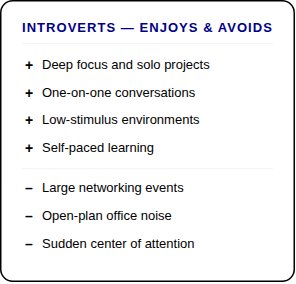
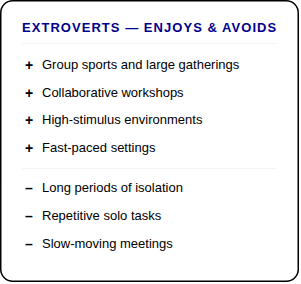
Activities: what energizes each type
How we spend our downtime is one of the clearest indicators of where we sit on the spectrum.
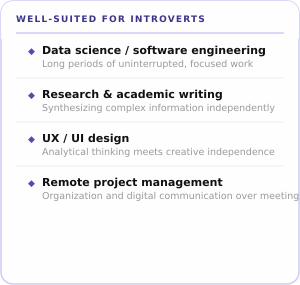
Ideal career paths
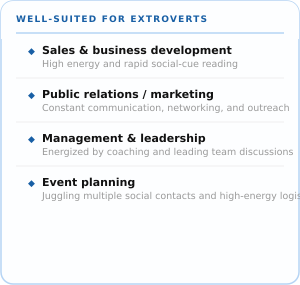
Both types can succeed in virtually any field. But certain roles naturally align with each type’s energy flow, making deep engagement more sustainable over the long term.
The perception gap — and how to close it
One of the most persistent sources of workplace friction is the perception gap: the misreading that each type projects onto the other.
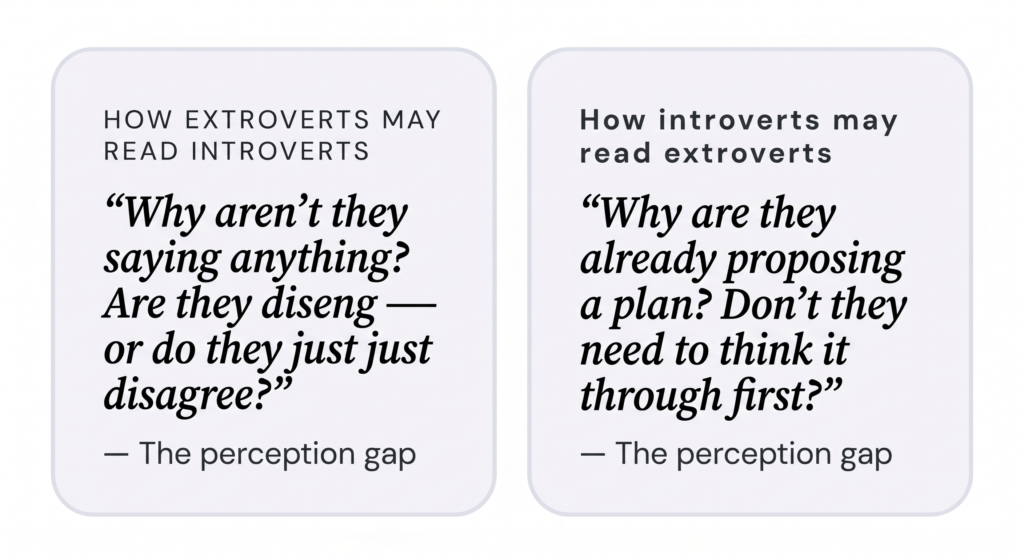
Closing this gap requires metacognition — an awareness of one’s own processing style and a genuine curiosity about others’. Extroverts use talking as a tool to think through ideas; introverts use silence as an active period of internal processing. Neither silence nor verbosity signals disengagement — they are simply different cognitive styles in action.
Building a team that works for both
High-performing teams don’t ask introverts to “be more outgoing” or extroverts to “just sit still.” Instead, they engineer the environment:
Provide think time before meetings — share agendas and questions in advance so introverts can arrive prepared. Provide talk time during meetings — structured open discussion gives extroverts the verbal engagement they need to think and contribute at their best. By respecting these biological differences, teams don't just improve morale — they optimize collective intelligence.
Research sources
Jung, C. G. (1921). Psychological Types.
Cain, S. (2012). Quiet: The Power of Introverts in a World That Can’t Stop Talking. Laney, M. O. (2002). The Introvert Advantage.
Grant, A. M. (2013). Rethinking the Extraverted Sales Ideal.
Derryberry, D., & Reed, M. A. (1994). Temperament and Attention.