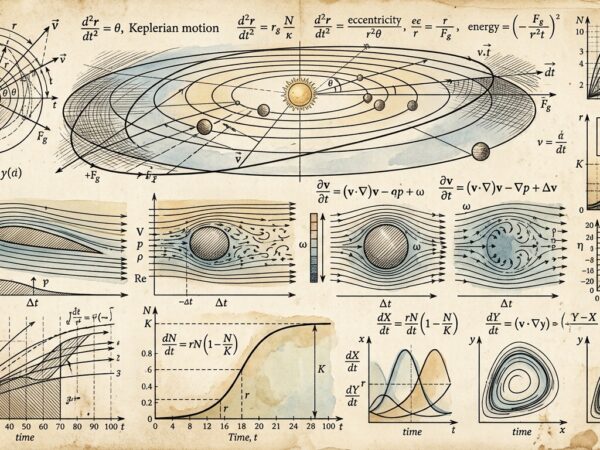
Every falling object, cooling cup of coffee, decaying isotope, and spreading epidemic obeys the same underlying logic: change does not happen all at once — it happens at a rate, and that rate is itself a function of the system’s current state. A differential equation is the formal sentence that records this fact. What follows traces how that sentence was invented out of necessity in the late seventeenth century, defines its working vocabulary in plain language, solves one completely by hand — the decay of radioactive carbon — and surveys the circuits, organisms, and economies still running on it today.
Read More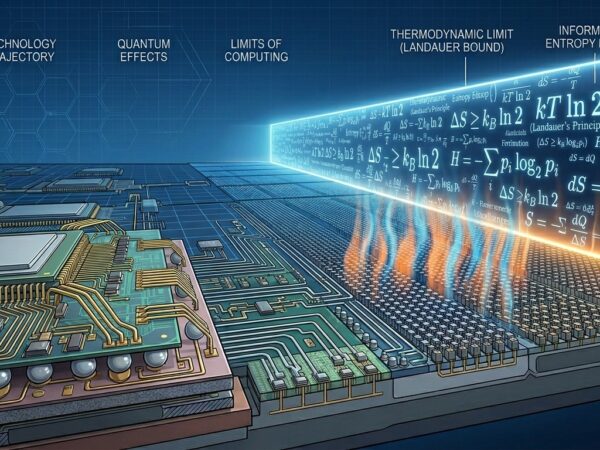
Limits of Computation?
For sixty years, the number of transistors on a chip doubled at a steady rate — a pattern called Moore’s Law. That doubling has slowed. This article reconstructs why. We separate two very different kinds of limit: the engineering limits (heat, electrical leakage, the cost of printing ever-tinier patterns) and a single physical limit set by the laws of thermodynamics. We will define every term as we go, derive the physical floor of computation from first principles with arithmetic you can check by hand, and then ask the honest question: when computers stop getting faster, which wall did we hit?
Read More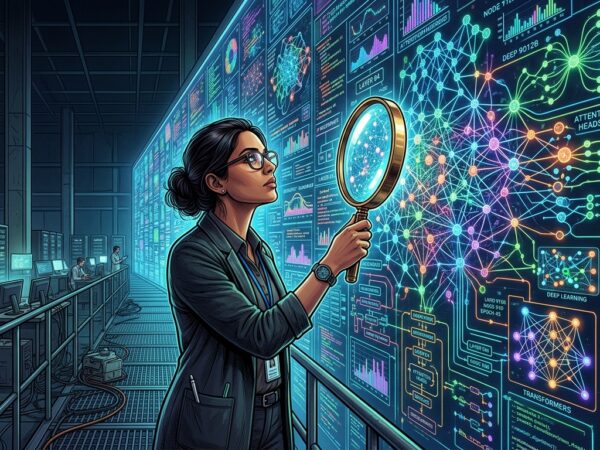
Hidden Patterns in a World of Information
Imagine you receive a box containing ten thousand marbles scattered in every direction. Each marble is a different color and carries a different number. You could count them. You could sort them by shade, average their values, map their distribution on a histogram. These are all legitimate moves in the classical statistician’s playbook
Read More
The Mathematical Revolution of Évariste Galois
To understand why Galois matters, we must begin with a problem that seems, on its surface, completely straightforward: can you find a formula that solves any polynomial equation? The answer, it turns out, depends entirely on the degree of the polynomial — and the story of how mathematicians discovered this is one of the most dramatic in the history of science.
Read More
Unlocking the Mystery of Prime Factorization
Every time you load a web page over HTTPS, complete a bank transfer, or send an encrypted message, an ancient mathematical idea silently stands guard. That idea — prime factorization — was pondered by Greek geometers two millennia before electricity existed. Today it underpins roughly 90% of encrypted global internet traffic. And today, for the first time in its history, it faces an existential threat.
Read More
Why the Normal Distribution Rules Our Lives
There is a shape that appears in the height of soldiers measured by 19th-century army physicians, in the noise patterns of electronic circuits, in the weight of apples picked from a single orchard, and in the scores of millions of students sitting for the same exam. It curves up toward a single peak, descends symmetrically on both sides, and tapers into thin tails that never quite touch zero. To a statistician, it is simply the Normal Distribution. To the world at large, it is the hidden architecture beneath an enormous swath of reality.
Read More
The Jacobian Matrix
Few mathematical constructs sit as quietly beneath the surface of modern technology as the Jacobian matrix — and yet, once you learn to see it, it appears everywhere. It governs the motion of a robotic arm assembling a car. It enables a spacecraft to orient itself in orbit. It drives the back-propagation algorithm that trains nearly every large neural network you interact with. It is the mathematical bridge between a system’s inputs and its outputs, between coordinates and forces, between the abstract and the real.
Read More