How a 20-year-old duelist’s last night of scribbling became the foundation of modern algebra — and solved puzzles that stumped the world for 300 years.
April 23, 2026·7 min read·Mathematics
Picture this: it’s 1832, and a 20-year-old French mathematician named Évariste Galois is up all night scribbling furiously by candlelight. He knows he’s fighting a duel at dawn — and that he’ll probably lose. So he does what any self-respecting math genius would do: he writes down the most important ideas of his life before the sun comes up.
Those pages, hastily written and full of margin notes, helped launch an entirely new branch of mathematics. Today it’s called Galois Theory, and it connects two seemingly unrelated areas of math — field theory and group theory — in a way that solved one of algebra’s longest-standing mysteries.
Let’s break down what that actually means — no college degree required.
The 300-year puzzle nobody could crack
To understand why Galois’s work mattered so much, you need to know the backstory. It starts with equations.
You’ve probably solved equations like x² − 5x + 6 = 0 in class using the quadratic formula. That formula has been around for centuries, and it works for any second-degree equation (one where the highest power of x is 2). Mathematicians also worked out formulas for third-degree (“cubic”) and fourth-degree (“quartic”) equations. The Italian mathematician Gerolamo Cardano published those solutions way back in 1545 in a famous book called Ars Magna.
So naturally, everyone assumed they’d eventually find a formula for fifth-degree equations (called “quintic” equations) too. They spent the next 300 years trying.
What’s a quintic equation? Just an equation where the highest power is 5 — something like x⁵ − x + 1 = 0. Finding a universal formula for these sounds like it should be straightforward. It was not.
Abel’s bombshell — and Galois’s upgrade
- 1545 – Cardano publishes Ars Magna, giving the world formulas for cubic and quartic equations.
- 1826 – Norwegian mathematician Niels Henrik Abel proves a shocking truth: a universal formula for quintic equations (using only basic arithmetic and roots) is impossible. Any such formula would create an unavoidable mathematical contradiction.
- 1830 – Évariste Galois, not yet 20 years old, takes Abel’s proof and goes further — creating a method that works for any polynomial equation, not just quintics. Modern algebra is born.
Abel proved the quintic formula couldn’t exist. But Galois asked a deeper question: which equations can be solved with a formula, and which ones can’t — and why? His answer changed everything.
“Galois didn’t just answer the old question. He built a machine for asking entirely new ones.”
The big idea: symmetry is the secret
Galois’s key insight was to stop thinking about numbers and start thinking about symmetry. Here’s the basic setup, step by step.
Step 1
Start with a field — a number system where you can add, subtract, multiply, and divide freely. The rational numbers (fractions) are a classic example.
Step 2
Some equations have roots that fall outside your field. For example, x² − 2 = 0 has roots ±√2, which aren’t rational. So you “extend” the field by inviting those roots in — creating an extension field.
Step 3
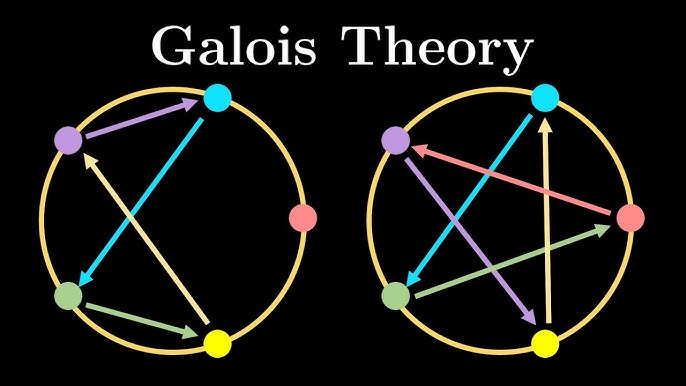
Now ask: in how many ways can you swap or rearrange the roots of your equation without breaking any of the arithmetic relationships? Those valid rearrangements form the Galois group.
Step 4
Analyze the structure of that group. If it has the right kind of subgroup structure (called “solvable”), the equation can be solved with a radical formula. If not, it can’t.
Think of it like a Rubik’s Cube. The “moves” you can make on a Rubik’s Cube form a group — a collection of symmetries. Galois realized that the symmetries of an equation’s solutions tell you everything about whether and how those solutions can be found.
The fundamental theorem — the heart of it all
At the center of Galois Theory sits one elegant result called the Fundamental Theorem of Galois Theory. It establishes a perfect one-to-one correspondence (mathematicians call it a “bijection”) between two different things: the subfields sitting inside your extension field, and the subgroups sitting inside your Galois group.
In plain English: every time you find a smaller “number world” living inside your big number world, there’s a matching symmetry pattern living inside your symmetry group — and vice versa. The two structures are mirror images of each other.
An analogy that might help: Imagine you have a deck of playing cards (the Galois group) and a map of all the different ways to sort them (the subfields). The fundamental theorem says the structure of the sorting map and the structure of the deck correspond to each other perfectly — every sorting rule has exactly one deck pattern, and every deck pattern has exactly one sorting rule.
Why does any of this matter?
Beyond solving the quintic mystery, Galois Theory turned out to answer some ancient geometry puzzles that had stumped thinkers since Ancient Greece. Is it possible to trisect any angle using only a compass and straightedge? Can you construct a cube with exactly twice the volume of another using those tools alone?
The answer to both, it turns out, is no — and Galois Theory is precisely what lets mathematicians prove that, by showing the underlying field extensions don’t have the right structure.
More broadly, Galois’s shift in perspective — from “what’s the answer?” to “what’s the structure?” — planted the seed for all of modern abstract algebra. By the early 1900s, mathematicians had formalized his intuitions into the concepts of groups and fields that are still taught in university math programs today.
The legacy of a short life
Galois died in that duel on May 31, 1832, at just 20 years old. The full details of why the duel took place remain debated by historians, though romantic and political entanglements both appear to have played a role. What’s not debated is that his mathematical output in his short life was extraordinary.
His manuscripts weren’t even properly published until 1846 — fourteen years after his death — when mathematician Joseph Liouville recognized their importance and brought them to the world’s attention. From those hastily written pages, an entire field of mathematics grew.
Next time your algebra homework feels brutal, just remember: someone once solved a 300-year-old math mystery the night before a fatal duel. Your problem set is fine.