The Cosmic Speed Limit: Why Time Bends When You Move Fast
In the world of modern physics, time isn’t the steady, unchanging ticking of a clock we imagine it to be. Instead, it’s flexible. One of the most mind-bending discoveries of Albert Einstein’s theory of special relativity is time dilation: the fact that the faster you move through space, the slower you move through time. [1, 2]
The One Rule That Breaks Reality
To understand why this happens, you only need to know one rule: The speed of light ( ) is absolute.
In our everyday lives, speeds add up. If you throw a ball at  while standing on a train moving at
  , a person on the ground sees the ball moving at
  . But light doesn’t work that way. Whether you are standing still or flying in a rocket at
  , a beam of light will always pass you at exactly the same speed: roughly
  . [2, 3, 4]
The Light Clock: A Thought Experiment
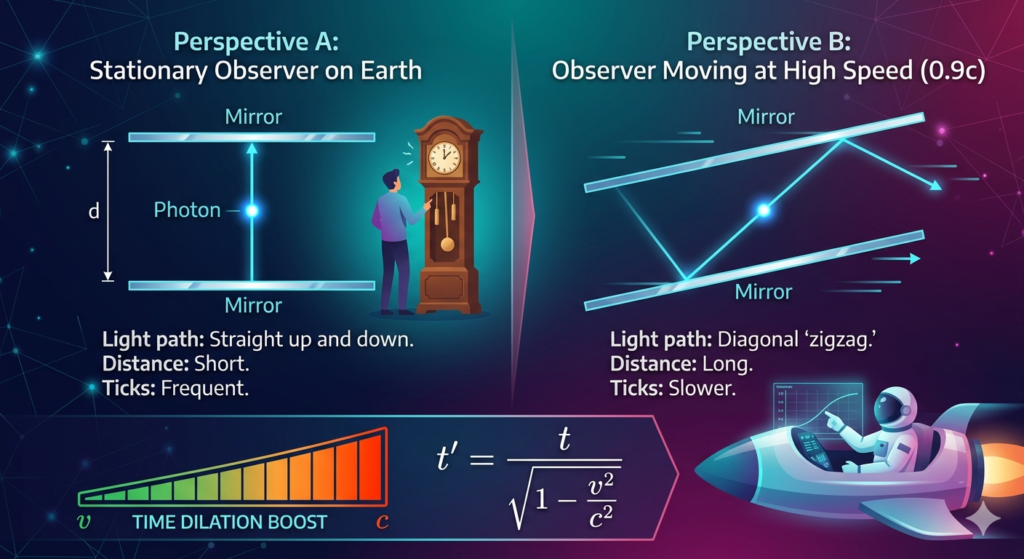
Imagine a clock that works by bouncing a single particle of light (a photon) between two mirrors—one on the floor and one on the ceiling. Each bounce is one “tick” of time. [5]
- At Rest: From your perspective inside the ship, the photon travels straight up and down. The distance is short, and the ticks are steady.
- In Motion: If that clock zooms past an observer on the ground, they don’t see the photon going straight up and down. Because the ship is moving forward at velocity
 , the photon must travel a diagonal path to hit the mirrors. [2, 6]
A diagonal line is longer than a straight vertical one. Since the photon has a longer distance to travel, but its speed cannot change, it takes longer to complete one tick. To the observer on the ground, the moving clock has slowed down. [6]
The Lorentz Factor: Calculating the Lag
Physicists use the Lorentz Transformation to calculate exactly how much time “dilates” based on your velocity () relative to the speed of light (). The formula is:
![\[t' = \frac{t}{\sqrt{1 - \frac{v^2}{c^2}}}\]](https://jeremyfaith.me/wp-content/ql-cache/quicklatex.com-fd30c09b27520c5c8e28b6cc62918772_l3.png "Rendered by QuickLaTeX.com")
Where:
 is the time observed by the stationary observer.
 is the “proper time” measured by the person in motion.
- is the velocity of the moving object.
- is the constant speed of light. [7, 8]
As approaches , the denominator  gets closer to zero, causing to stretch significantly. [6, 9]
Is This Actually Real?
This isn’t just science fiction; it is a proven law of the universe that affects our modern technology:
- GPS Satellites: Because they orbit Earth at high speeds, their internal atomic clocks tick slightly slower than clocks on the ground. Engineers must program relativistic corrections into the software, or your phone’s GPS would be off by kilometers within a single day.
- Astronauts: After spending months on the International Space Station, astronauts return to Earth technically having aged slightly less—often by a few milliseconds—than if they had remained on the ground. [10, 11, 12]
Time dilation reminds us that space and time are not separate—they are woven together into a single fabric called spacetime. [13, 14]
Would you like to explore the “Twin Paradox” or see how gravity also causes time to slow down?
[1] https://www.bbc.com
[2] https://www.youtube.com
[3] https://www.reddit.com
[4] https://www.khanacademy.org
[5] https://www.youtube.com
[6] https://www.youtube.com
[7] https://www.youtube.com
[8] https://study.com
[9] https://www.kroneckerwallis.com
[10] https://www.space.com
[11] https://www.thoughtco.com
[12] https://www.ebsco.com
[13] https://www.reddit.com
[14] https://www.sciencetimes.com